


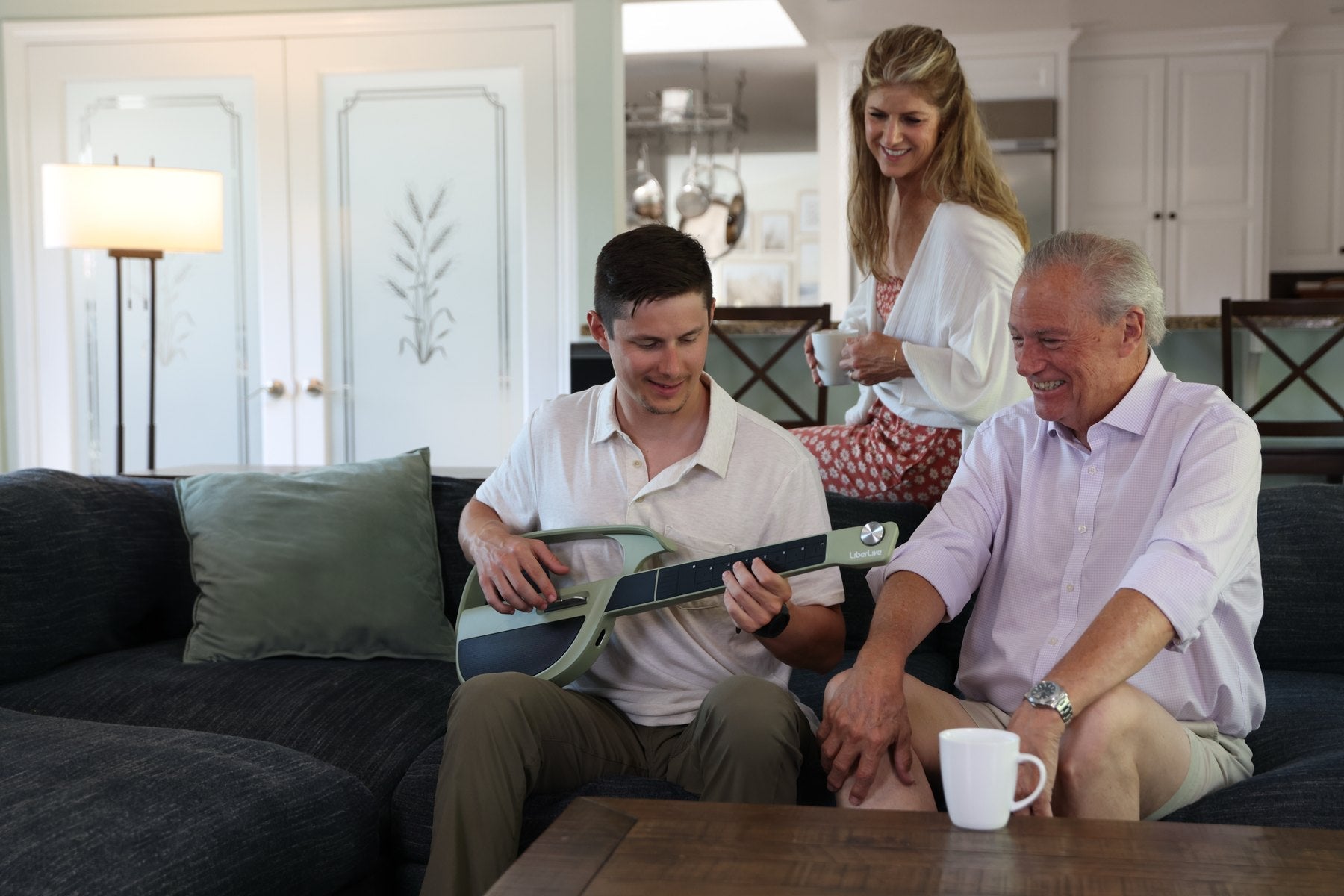
Short answer: yes, if you define the goal honestly.
A smart guitar can help a complete beginner get into simple songs, chords, rhythm, and singing accompaniment with no guitar background. It cannot hand you the physical skills of an acoustic or electric guitar.
That is the line to keep in mind. If "start playing" means making music sooner, a smart guitar can help. If it means skipping every hard part of learning guitar, it will disappoint you.
A product like LiberLive C1 is built for the first version. It lowers the early barriers with chord pads, strumming paddles, app-guided songs, built-in sounds, and no traditional string tuning. It is not a full replacement for traditional guitar training.

Quick answer: yes, if you mean songs, not mastery
A beginner can start using a smart guitar without previous guitar experience. The more honest question is what kind of playing you expect.
On LiberLive C1, the first session does not begin with sore fingertips, open chord shapes, tuning pegs, and a blank chord chart. You press chord pads, strum or pick with the built-in controls, and use the LiberLive app when you want chord sheets, guidance, rhythm patterns, tutorials, or custom chords.
That gives a beginner a smaller job:
- Find the chord.
- Keep time.
- Follow the song.
That is enough to feel like music. It is not the same as becoming a guitarist overnight.
What beginners are trying to avoid
Most people searching for "smart guitar for beginners" are not asking a technical product question. They are asking whether they are going to bounce off guitar again.
Traditional guitar can feel harsh in the first few weeks. Fingers hurt. Chords buzz. The strumming hand drifts. Tuning feels like a side quest. A song that looked easy online suddenly has too many moving parts.
So the real questions are usually these:
- Can I make a clean sound before my fingertips toughen up?
- Can I play a song before I understand every chord shape?
- Can I follow something instead of guessing what to do next?
- Can I sing with simple backing?
- If I start on a smart guitar, what will I still need to learn later?
That is the real decision. The point is not whether a smart guitar is "real" enough. The point is whether it solves the beginner's first problem without pretending to solve all of them.
What LiberLive C1 makes easier
It removes the first chord-shape fight
Traditional guitar starts with finger placement. Even a basic chord can ask a beginner to place several fingers, press hard enough, avoid muting nearby strings, and move to the next shape before the rhythm falls apart.
LiberLive C1 changes that first step. Instead of forming every chord on strings and frets, you use chord pads to select chords. LiberLive's FAQ says beginners do not need guitar experience or music theory to get started. It also says basic mode uses seven scale-degree chords, while custom mode lets users set chord pads through the app.
That does not make chord knowledge pointless. It just changes what you learn first. You can start by hearing how songs move from chord to chord, then learn the deeper theory or traditional shapes later if you want them.

It gives strumming a simpler starting point
Rhythm still matters. If a beginner instrument only had buttons, it could feel more like operating a remote than playing music.
C1 keeps a strumming motion through its paddles. You still have to feel the beat, pause in the right places, and move when the song changes. The difference is that you are not also dealing with string resistance, pick angle, fret buzz, and sore fingers at the same time.
For a new player, that is a big reduction. The motion is simpler, but it still points you toward rhythm.
It gives you something to follow
A normal guitar can feel blank when you first pick it up. What song should you try? Where are the chords? How fast should you play? What do you do when the song moves to the next section?
The LiberLive app helps answer those questions. The current app page describes chord sheets, light guidance, rhythm patterns, tutorial videos, custom chords, and guitar, piano, and bass sound options. The FAQ also says the app is free to use and does not require in-app purchases.
For a beginner, guidance is not decoration. It is the difference between owning an instrument and knowing what to try next.
It skips traditional string tuning
Traditional guitars depend on string tension. If the strings are out of tune, even correct fingers can sound wrong.
LiberLive C1 is an electronic instrument, so the official FAQ says it does not need traditional string tuning. Key changes happen through transpose controls instead of tuning six open strings.
That does not remove every setup choice. You still need the right key, volume, rhythm, sound mode, and app settings for the song. But it removes one common beginner doubt: "Is this sounding bad because of me, or because the guitar is out of tune?"
What still takes real practice

Finger strength and fretted chord shapes
A smart guitar can get you into songs earlier. It cannot give your fingers the same training they get from pressing real strings.
If your goal is to become an acoustic or electric guitarist, you will still need time on a traditional guitar. That means fingertip strength, chord shapes, hand position, and fretboard comfort.
C1 is strongest as a low-friction song and accompaniment instrument. It is not a substitute for the physical work of traditional guitar.
Picking, muting, bends, and touch
Traditional guitar technique is physical. Players learn pick control, string muting, fingerstyle patterns, bends, vibrato, slides, dynamics, and the small touch changes that make one player sound different from another.
A stringless smart guitar will not fully teach those skills. It can help with timing, chord movement, song structure, and confidence. It will not recreate the feel of a string under your fingers.
If those techniques are the goal, use a traditional guitar as the main path. A smart guitar can still be useful for quick backing, writing ideas, or casual playing.
Timing and listening
"Beginner-friendly" does not mean "no practice."
You still have to listen to the song. You still have to come in on time. You still have to move between chords cleanly. You still have to keep a pulse instead of rushing through the hard parts.
The benefit is that the first practice problem gets smaller. You are not dealing with tuning, fingertip pain, chord shapes, rhythm, and song structure all at once. You can start with rhythm and chord flow.
That is useful. It is not magic.
A realistic first week with a smart guitar
If you are starting from zero, resist the urge to use every feature on day one. Make the first week boring enough that you actually finish it.
- Pick one easy song from the app or use a simple chord chart.
- Play slowly before you try to sound impressive.
- Use one rhythm pattern until your timing feels steady.
- Practice the chord changes without singing first.
- Add singing only after the chord flow feels comfortable.
- Try custom chords or transpose only when you know why you need them.
That path is not glamorous, but it works better than jumping around. The first win is not mastery. The first win is finishing a song and wanting to pick the instrument up again tomorrow.

Who this path fits, and who should be careful
The right beginner path depends on what you want from music.
| Beginner goal | Smart guitar fit | Why |
|---|---|---|
| Sing with chord backing | Strong fit | C1 focuses on chord accompaniment, app songs, and simple strumming. |
| Play recognizable songs quickly | Strong fit | Chord pads and app guidance reduce the first-session load. |
| Avoid early finger pain from strings | Strong fit | You do not press traditional strings into frets. |
| Learn full acoustic or electric guitar technique | Limited fit | You still need real strings for fretting, picking, muting, and expression. |
| Produce music with MIDI in a DAW | Limited fit | A MIDI guitar or controller is usually a better category. |
| Buy a low-friction music gift | Good fit | The recipient can try songs without a long lesson plan first. |
Choose a smart guitar if your first goal is access: songs, singing, rhythm, and casual playing.
Choose a traditional guitar if your first goal is technique: frets, strings, picking, tone, and long-term guitar skill.
Useful next reads if you are still comparing
If you are still defining the category, start with What Is a Smart Guitar? That article explains the main types: app-connected guitars, stringless smart guitars, MIDI guitars, and guided-learning systems.
If you are comparing products, read Best Smart Guitars in 2026. That guide is better for choosing between LiberLive C1, LAVA GENIE, AeroBand, Jamstik, Enya, and learning add-ons.
If the smart, digital, and MIDI labels are blurring together, use Smart Guitar vs Digital Guitar vs MIDI Guitar. That page separates beginner access, built-in effects, and music production tools.
If you already know you want the low-friction beginner path, go straight to the LiberLive C1 product page, the LiberLive app page, and the FAQs.
FAQ
Can I use LiberLive C1 with no guitar experience?
Yes. LiberLive's FAQ says you do not need guitar experience or music theory to start using LiberLive C1. You can press chord pads, strum or pick, and follow songs in the app.
Do I need music theory to start?
No. You can start by following chord pads and song guidance. Music theory can help later, especially if you want to understand keys, chord functions, custom chords, or transposition, but it is not required for the first session.
Can LiberLive C1 work without the app?
Yes. The FAQ says C1 can be used without the app. The app adds more features, including song resources, custom chords, rhythm pattern switching, drum machine options, tempo adjustments, and pitch or key controls.
Will a smart guitar teach me traditional guitar?
Only partly. It can help with rhythm, chord movement, song confidence, and accompaniment. It will not fully teach fretting strength, chord-shape memory, picking control, muting, bends, or other real-string techniques.
Can I play any song on a smart guitar?
You can play songs from the LiberLive app and also play outside the app if you have the chords or a chord chart. The FAQ says users can use their own chord charts and adjust chords or rhythms in the app. Some songs will still be harder than others because of key, chord changes, rhythm, or tempo.
Does LiberLive C1 need tuning?
No, not in the traditional guitar sense. The FAQ says LiberLive C1 is an electronic instrument and does not need traditional string tuning. Key changes happen through transpose controls instead of retuning strings.
Final takeaway
A smart guitar can be a real starting point for beginners, as long as "starting" means the right thing.
LiberLive C1 can reduce the blockers that stop many first-time players: painful string pressure, slow chord shapes, confusing song setup, and traditional tuning. It can help you play songs, sing with backing, practice rhythm, and build confidence sooner.
It cannot replace the full physical training of a traditional guitar. If your goal is acoustic or electric technique, you still need real strings.
So make the decision by use case. If you want the fastest route into songs and accompaniment, start with LiberLive C1. If you want to become a traditional guitarist, treat a smart guitar as a side path, not the whole road.
Share this article:
LiberLive C1 vs LAVA GENIE: Which Stringless Smart Guitar Fits You?
What Is a Stringless Guitar? How It Works, What It Is Not, and Who It Suits