


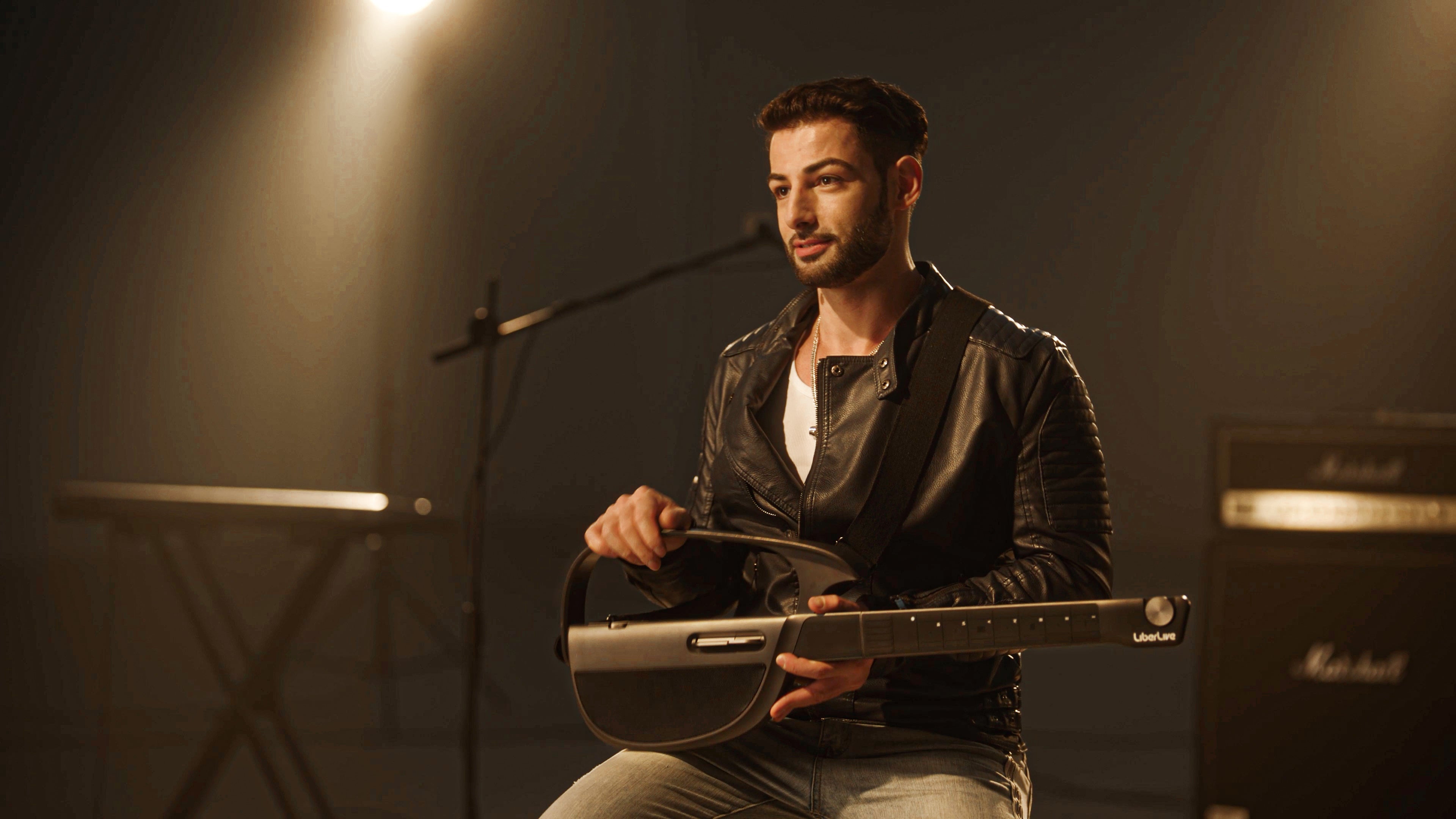
Most singers do not need a guitar that wins a gear debate. They need something that can sit under the voice and behave: clean chords, a steady rhythm, and a key that does not make the chorus feel like a fight.
For some singers, the right answer is still a traditional acoustic guitar. It sounds natural, it is flexible, and once your hands know the shapes, it can follow almost any song. The problem is the "once your hands know the shapes" part.
If you want accompaniment first, before full guitar technique, a stringless smart guitar like LiberLive C1 deserves a look. It is not trying to turn you into a traditional guitarist overnight. It is built for a simpler job: press chords, strum, and sing.

Quick answer: what is the best guitar for singers?
If you want to become a guitarist who also sings, buy a real guitar and learn the normal path: tuning, chord shapes, finger pressure, strumming, timing, and songs.
If you want to sing with live chord backing sooner, choose the instrument that removes the most friction from accompaniment. Look for:
- chords you can hit cleanly while singing
- a rhythm motion that feels natural
- key changes that fit your vocal range
- built-in sound or easy output to speakers or headphones
- chord sheets, lyrics, or app guidance when you do not already know the song
That is the singer's version of "best." It is less about the guitar spec sheet and more about whether the instrument lets you keep your voice in charge.
Start with the singing job, not the guitar spec sheet
A singer's accompaniment instrument has one job before all others: support the vocal.
That sounds obvious until you try to sing while your fretting hand is late, the chord buzzes, the key sits too high, or the backing track refuses to slow down. The wrong instrument can make the voice feel like the second priority.

The chord part should be easy to hold
Singing already takes attention. You are tracking lyrics, pitch, breath, phrasing, timing, and the emotional shape of the song. If your left hand is still fighting every chord change, the vocal pays for it.
Traditional guitar can become a great singer's instrument. It just asks for patience. Open chords, clean pressure, muted strings, buzzing notes, and chord transitions all need repetition before they stop interrupting the song.
For a singer who wants accompaniment first, easy chord access is not a side benefit. It is the reason to choose this kind of instrument.
The key has to fit your voice
The original key is not sacred. A song that sounds relaxed for one singer can feel tense for another.
On a traditional guitar, changing key may mean using a capo, learning different chord shapes, retuning, or rewriting the chart. Guitarists get used to that. Singers often just want to move the song until it sits in the right place.
Good accompaniment should follow the voice. If the instrument makes key changes hard, it is adding work at the exact moment the singer needs relief.
Rhythm matters more than flashy guitar features
Most singers need the rhythm to hold together. They do not always need lead lines, complex picking, effects, or a full stage rig.
A simple down-up strum can be enough if it keeps the song moving. A basic rhythm pattern can be enough if it gives the vocal a floor to stand on.
That is why a singer's best guitar may look plain to a guitarist. It is doing a different job.
Common accompaniment choices for singers
| Option | Best fit | What works well | What gets in the way |
|---|---|---|---|
| Traditional acoustic guitar | Singers who want real guitar skill | Natural sound, expressive feel, no electronics required | Tuning, finger strength, chord shapes, and practice all come first |
| Electric guitar | Singers in bands, recording setups, or amplified rooms | Flexible tones and good stage control | More gear, more setup, and still the same guitar technique problem |
| Keyboard or piano | Singers who care most about key control | Clear harmony and easy transposition on many setups | No guitar-style strumming feel |
| Backing tracks or karaoke | Singers practicing a full arrangement | Instant full-band sound | Less flexible if you want to slow down, repeat a section, or change the feel |
| Stringless smart guitar | Singers who want fast chord accompaniment | Easier chord access, strumming motion, app support, and key controls | It does not train traditional fretting, picking, or full guitar technique |
This is not a ranking. It is a fit check. If you want the feel and training of real strings, choose real strings. If you want live chord backing without waiting months to begin, a stringless smart guitar is a different kind of answer.
When a traditional guitar is still the right answer
Choose a traditional guitar if the guitar itself is part of the dream.
Real strings give you tension, pick attack, bends, muting, fingerstyle, fretboard movement, and dynamics that a stringless instrument cannot fully copy. If you want to play acoustic parts as written, learn barre chords, build lead lines, or grow into electric technique, you should not skip that work.
A stringless smart guitar can help with rhythm, song structure, chord movement, and confidence. It cannot give you the physical training of a standard acoustic or electric guitar.
That boundary matters because it keeps the choice honest. A singer who wants simple backing has a different problem from someone who wants to study guitar as a main instrument.

Where LiberLive C1 fits
LiberLive C1 fits when the vocal is the center and the guitar part is there to support it.
The official product page describes the basic flow as pressing a chord, strumming with the paddle, and following the app for real-time chord sheets and lyrics. That is close to the singer-accompaniment job: choose the harmony, keep time, and stay with the words.

Press chords, then sing
On a traditional guitar, a basic chord can take three fingers, clean pressure, and a clean change into the next shape. If any part is late, the song wobbles.
On C1, chord pads handle the chord selection. The official FAQ says basic mode uses seven scale-degree chords that change when you transpose the key. In custom mode, you can set chord pads through the app, with 72 chord options across 12 root notes.
That does not make the player a traditional guitarist. It does make the first accompaniment job simpler, which is exactly what many singers need.
Strum instead of pressing play
Backing tracks are useful, but they are fixed. If you want to hold a phrase, repeat a chorus, or soften the rhythm for a verse, the track will not naturally follow you.
C1 keeps a live strumming action. The product page describes strumming with the paddle to trigger the sound, so you still control the feel in real time.
That is a small difference on paper and a big one when singing. A live strum can breathe with the voice in a way a fixed track usually cannot.
Use the app when you need the chart
The LiberLive app page describes chord sheets, light guidance, rhythm patterns, guitar, piano, and bass tones, and tutorial videos. The FAQ says C1 can work without the app, while the app adds song resources, custom chords, rhythm pattern switching, drum machine options, tempo adjustments, and pitch or key controls.
For singers, the useful part is not just "more features." It is having the song in front of you: lyrics, chords, rhythm help, and a way to build or adjust a chart when the simple version is not enough.
Because app features and song-library terms can change, check the current LiberLive app page and FAQs before buying if one specific app feature matters to you.
Move the key toward your range
If a chorus is too high, you feel it before anyone else does.
The official FAQ says LiberLive C1 supports key changes without traditional tuning. You can use transpose from the device controls or through the app. The chord steps stay familiar while the actual chord sounds move with the selected key.
That is one of the strongest singer features. The accompaniment can move toward the voice instead of forcing the voice to chase the original key.
The honest limit: C1 is not guitar lessons
C1 should be judged by the job it is built for.
It does not replace:
- traditional fretting technique
- real-string finger pressure and callus building
- barre chord training
- picking dynamics on strings
- fingerstyle guitar
- electric guitar bends, vibrato, and muting
- full band interaction with human players
That limit does not make C1 weak. It makes it specific. It is strongest when the goal is song-first playing, easier accompaniment, and singing support.
If your goal is to sit with an acoustic guitar and play the full part exactly as written, learn traditional guitar. If your goal is to sing with chords under your voice without waiting months to begin, C1 is a practical option to test.
A quick buying check for singers
Before choosing an instrument, answer these honestly:
- Do I want to sing with accompaniment, or do I want to become a guitarist?
- Do I need the physical feel of real strings?
- Do I need quick key changes for my vocal range?
- Do I want a live strumming motion, or is a backing track enough?
- Would chord sheets, lyrics, rhythm patterns, or custom chords help me practice more often?
If most answers point to traditional skill, buy a guitar and plan for lessons or steady practice. If most answers point to quick vocal backing, choose an accompaniment-first instrument.
FAQs
What is the best guitar for singers?
The best guitar for singers depends on the job. A traditional acoustic guitar is best if you want real guitar skill and natural string feel. A stringless smart guitar like LiberLive C1 is better if you mainly want easier chord backing for singing.
Can I accompany myself without a band?
Yes. You can accompany yourself with acoustic guitar, keyboard, backing tracks, loopers, or a smart guitar. C1 is designed for a simple press-and-strum workflow, so it can work for singers who want chord backing without needing a guitarist or full band.
Is LiberLive C1 a real guitar replacement?
Not for traditional guitar training. C1 can replace a guitar for some casual accompaniment and singing use cases, but it does not replace real strings, fretting, fingerstyle, bends, or advanced guitar technique.
Can LiberLive C1 change keys for my vocal range?
Yes. The official FAQ says C1 supports key changes with the transpose function, either from device controls or through the app. That makes it useful when a song sits too high or too low for your voice.
Do I need the LiberLive app to play?
No. The official FAQ says C1 can be used without the app. The app adds more singer-friendly tools, including song resources, custom chords, rhythm pattern switching, drum machine options, tempo adjustments, and pitch or key controls.
Bottom line
The best guitar for singers is the one that lets the voice stay in front.
Choose a traditional guitar if you want the guitar to become a real second instrument. Choose a keyboard if key control matters more than guitar feel. Use backing tracks if you want a full arrangement and do not need live flexibility.
Choose LiberLive C1 if your main goal is easier live chord accompaniment: press chords, strum, follow song guidance when needed, and move the key toward your range. Before buying, review the LiberLive app and FAQs so the current features match the way you want to sing and play.
Share this article:
Portable Smart Guitar Guide: Travel, Small Apartments, and Quiet Practice