


What Is a Smart Guitar? A Beginner-Friendly Guide
A smart guitar is a guitar, or a guitar-like instrument, with digital features built in. Those features might help you learn songs, change sounds, record ideas, control music software, or play chords with less friction.
The confusing part is the word "smart." One smart guitar might be a normal guitar with an app and built-in effects. Another might be stringless, with chord pads and a strum paddle. Another might be closer to a MIDI controller.
So before asking which smart guitar to buy, it helps to understand what kind of smart guitar you are looking at.
What is a smart guitar?
The simple definition
A smart guitar adds digital tools to the guitar experience.
Some are traditional guitars with real strings and extra technology built in. Some remove the hardest parts of early playing, such as pressing chord shapes. Some are built for recording software. Some are learning systems with lights or app guidance.
That means "Is it a real guitar?" is not always the most useful question. Ask what the instrument is trying to make easier.
What makes a guitar "smart"
A guitar usually gets called "smart" when it can do one or more of these things:
- Connect to a mobile app for songs, settings, lessons, or updates.
- Add built-in effects, tuners, metronomes, loopers, or recording tools.
- Control software instruments through MIDI.
- Guide beginners with lights, chord charts, or app-based instructions.
- Simplify playing with chord pads, strum controls, or assisted chord systems.
- Produce sound through built-in speakers or direct audio output.
The feature only matters if it removes friction. A smart guitar should make playing, practicing, recording, or sound control easier than it would be with a basic guitar and a pile of extra gear.

How does a smart guitar work?
App control and song guidance
Many smart guitars use a mobile app as the control center. The app may show songs, chord sheets, tutorials, tuning tools, sound settings, or practice exercises.
For a beginner, that matters. A normal guitar can feel blank when you pick it up. An app can give you the next chord, the rhythm, or the song step instead of leaving you to guess.
Built-in sounds, effects, and speakers
Some smart guitars keep the normal guitar feel and add the gear players usually buy separately.
For example, an app-connected real guitar may include a speaker, effects processor, looper, tuner, metronome, or recording feature. You still press real strings. You just spend less time setting up amps, pedals, and apps before you can play.
MIDI and recording features
A MIDI guitar works differently. MIDI does not capture normal guitar sound like a microphone. It sends digital note information to software, so you can control synths, virtual instruments, and DAW tracks.
For producers, that can be the whole point. A MIDI guitar lets a guitarist trigger strings, pads, bass sounds, or electronic textures without switching to a keyboard.
For a total beginner who just wants to sing and play songs, MIDI is probably not the first thing to worry about.

Stringless or assisted playing systems
Some smart guitars are built to reduce the physical difficulty of guitar-style playing.
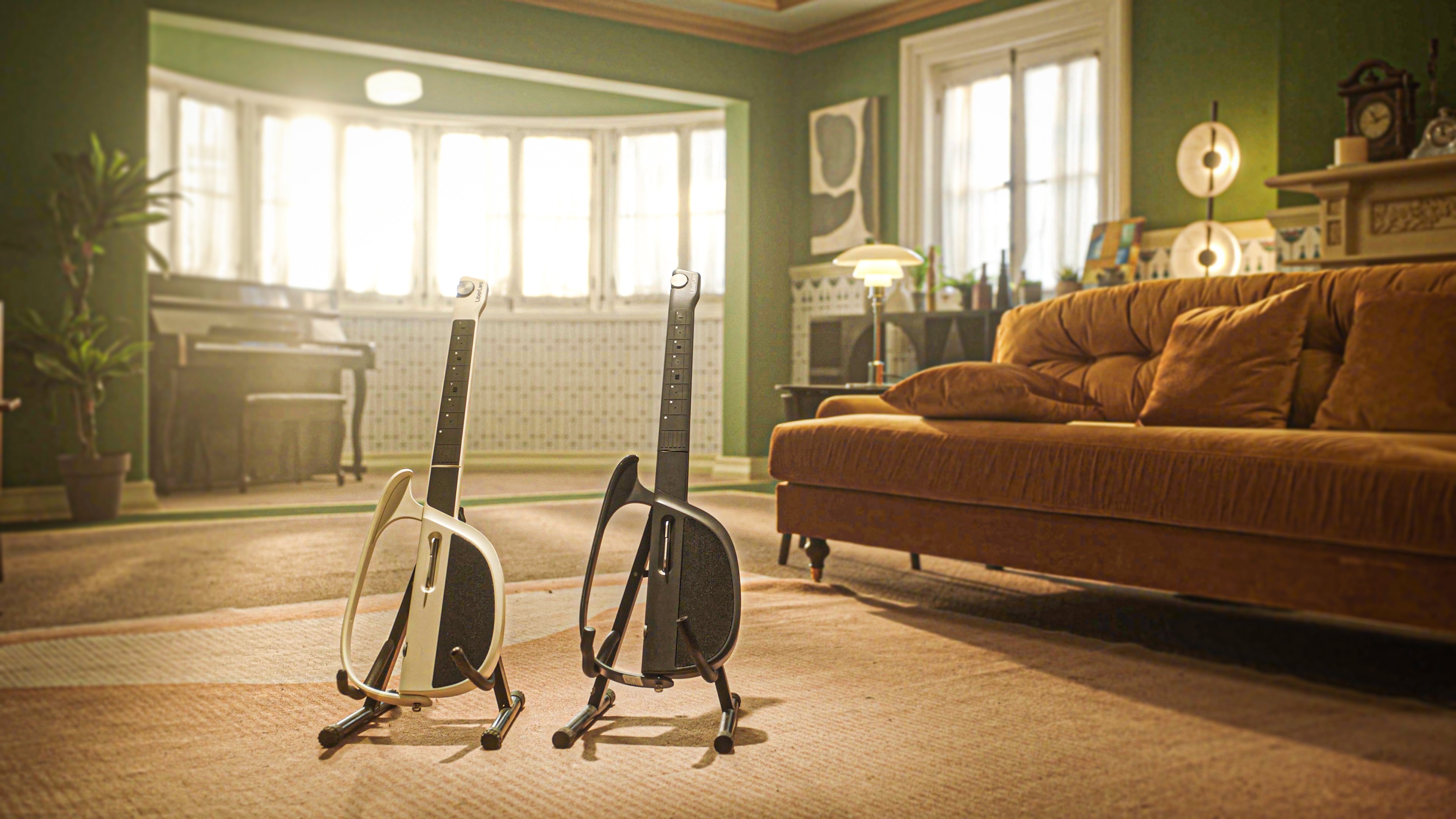
A stringless smart guitar may replace traditional strings with chord pads, touch controls, or a strum paddle. It is not trying to copy every detail of a traditional guitar. It is trying to help people play chords, follow songs, and accompany singing sooner.
The main types of smart guitars
App-connected traditional guitars
These are real guitars with digital tools added. They may include effects, app control, Bluetooth features, self-amplification, recording, looping, or software updates.
This type fits someone who still wants real-string technique but wants a cleaner practice setup. Your fingers still need to press strings, so the learning curve is still there.
Stringless smart guitars
Stringless smart guitars are built for fast access to songs and accompaniment.
Instead of asking you to memorize chord shapes and build finger strength first, they use an assisted interface. On LiberLive C1, for example, you press chord pads and use a strum paddle to play. The LiberLive app adds chord sheets, light guidance, rhythm patterns, sound options, and tutorial videos.
This can make the first session less intimidating for beginners, singers, casual players, and gift buyers. If you want traditional guitar technique, though, you still need real strings at some point.
MIDI smart guitars
MIDI smart guitars are mainly for software control and music production.
They make sense when you want guitar-shaped input for a DAW, synths, orchestral instruments, electronic sounds, or alternate tunings. Some keep a real guitar body and add MIDI hardware. Others feel more like digital controllers.
The catch is setup. MIDI, latency, software instruments, and recording workflow can be a lot if you simply want to play your first song.
LED or guided-learning systems
Guided-learning systems use lights, screens, or apps to show what to play.
Some attach to a guitar you already own. Others build guidance into the instrument itself. The idea is practical: show the note or chord position so the player does not have to decode everything from a chart.
This can help visual learners. The main question is skill transfer. Some systems teach real fretting positions. Others simplify the part so much that the transfer is limited.

Smart guitar vs traditional guitar
| Question | Smart guitar | Traditional guitar |
|---|---|---|
| Learning curve | Often easier at first, depending on type | Slower at first, especially chords and finger pressure |
| Real guitar technique | Strong on app-connected real guitars; limited on stringless systems | Full technique: fretting, picking, bends, muting, dynamics |
| Portability | Often designed for simple practice or travel | Depends on guitar size and whether you need an amp |
| Recording | Some models include direct output, MIDI, or app tools | Usually needs a mic, interface, amp, or extra gear |
| Beginner friendliness | Strong when the product matches the beginner's goal | Good long term, but the first month can be frustrating |
A traditional guitar teaches the full instrument from the beginning. A smart guitar usually makes one part easier: starting songs, following lessons, recording ideas, changing sounds, or controlling software.
Are smart guitars good for beginners?
Yes, if the type matches the beginner's goal.
If you want to play songs quickly and sing along, a stringless smart guitar can be a good starting point. It removes a few early blockers: painful chord shapes, slow chord changes, and not knowing what to play.
If you want to become a traditional acoustic or electric guitarist, choose a real-string path. You need the muscle memory that comes from fretting, picking, muting, and controlling dynamics.
If you care most about recording and production, look at MIDI features, audio outputs, DAW compatibility, and latency. A beginner song instrument and a production controller solve different problems.
A quick rule: choose by the job, not by the label.
Who should consider a smart guitar?
A smart guitar may make sense if:
- You are a singer who wants easy chord backing.
- You are a beginner who wants to enjoy songs before learning full technique.
- You are buying a gift for someone who likes music but may not commit to traditional lessons.
- You make short videos, demos, or song sketches.
- You already play guitar and want built-in effects, looping, or recording tools.
- You produce music and want guitar-shaped MIDI control.
It may not make sense if you want the pure feel of a traditional instrument or want classic guitar technique from day one.
Where LiberLive C1 fits in
LiberLive C1 sits in the stringless smart guitar category.
It is not built to replace every traditional guitar skill. It is built to help more people start playing songs. The design uses chord pads, a strum paddle, onboard sounds, and app-guided song support so beginners can get to music faster.

That makes C1 relevant for people who want to sing, accompany themselves, play casually at home, or make music without years of lessons first. The official FAQ also says C1 can be used without the app, while the app adds features such as custom chords, rhythm pattern switching, drum machine options, tempo, and pitch adjustments.
Think of C1 as an instrument built around access. If you want quick musical results, that is the point. If you want bends, fingerpicking, barre chords, and fretboard strength, treat C1 as a different path rather than a full substitute for a traditional guitar.
You can also review the LiberLive app and LiberLive FAQs if you want to check setup details before choosing.
FAQ
What is the difference between a smart guitar and a normal guitar?
A normal guitar is mainly an acoustic or electric instrument. A smart guitar adds digital features such as app guidance, effects, MIDI, speakers, LED learning, recording tools, or assisted controls.
Do smart guitars have strings?
Some do, some do not. App-connected traditional guitars usually have real strings. Stringless smart guitars use chord pads, touch controls, or strum triggers instead of fretted strings.
What is a stringless guitar?
A stringless guitar removes traditional strings from the playing interface. Instead of pressing strings against frets, the player may press chord pads, tap touch controls, or use a strum paddle. It is usually built for easier accompaniment, not traditional guitar technique.
Can a smart guitar teach you real guitar?
It depends on the product. A smart guitar with real strings can support traditional learning. A stringless smart guitar can teach rhythm, song structure, chord movement, and confidence, but it will not fully train fretting strength or picking technique.
Is a smart guitar easier than a regular guitar?
Some are easier at the beginning. Stringless smart guitars are usually easier for first songs because they reduce finger pain and chord-shape memorization. Real-string smart guitars still require normal guitar practice.
Do smart guitars need an app?
Some need an app for the best experience. Others can work without one. Check what still works offline or without the app, especially if you care about long-term use.
Final recommendation
If you are asking "what is a smart guitar," start with what you want to do.
If you want traditional technique, choose a real-string path and use smart features as support. If you want to record and control software, look at MIDI-focused instruments. If you want to play songs and sing sooner, a stringless smart guitar is the more direct route.
For that last use case, LiberLive C1 is the clearest LiberLive option. It is built for people who want music to feel playable in the first session.
When a smart guitar is designed well, that is what it does. It makes the next musical step easier to take.
Share this article:
What Is a Stringless Guitar? Discover the Next Era of Music Tech Innovation
Smart Guitar vs Digital Guitar vs MIDI Guitar: What's the Difference?