


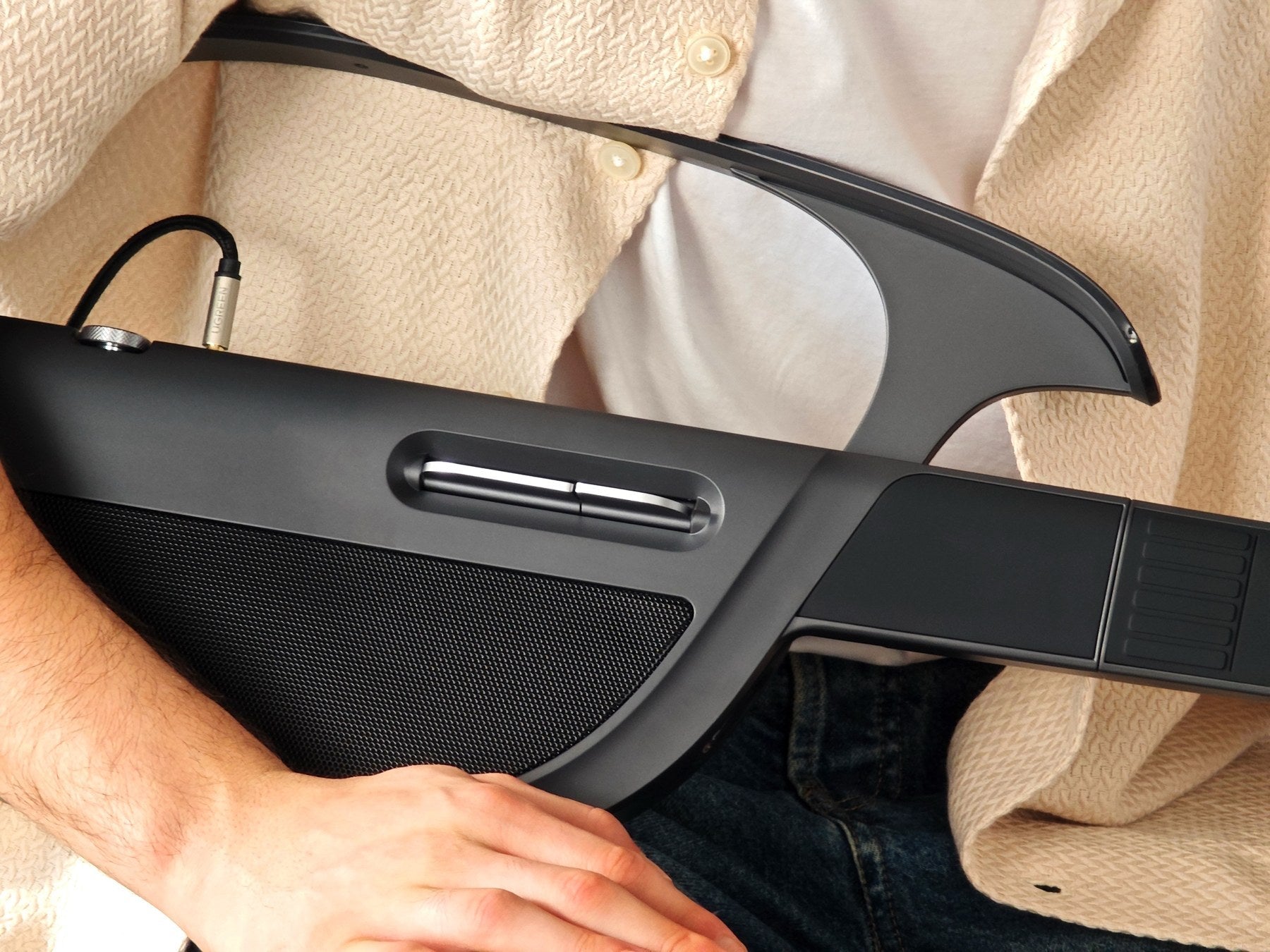
A stringless guitar is a guitar-style electronic instrument that does not use normal vibrating strings as the main playing surface. Instead of pressing strings against frets, the player chooses chords with pads, buttons, or touch areas, then triggers the sound with a strum or picking control.
If you landed here because a regular acoustic guitar has no strings on it, that is a different problem. That guitar needs strings before it can be played normally. This article is about guitars designed from the start to play without a traditional string-and-fret setup.
The category is useful, but only when the limits are clear. A stringless guitar can make chords and songs easier to start. It does not turn into a traditional acoustic or electric guitar just because the body shape looks familiar.

Quick answer: what is a stringless guitar?
In practice, a stringless guitar replaces string tension and fretted finger shapes with electronic controls. It still borrows a lot from guitar playing: chord changes, strumming rhythm, accompaniment, and the idea of following a song from one section to the next.
What changes is the first step. A beginner does not have to press steel strings hard enough to avoid buzzing. They do not have to tune six strings before playing. They do not have to memorize a full chord shape before hearing a clean C or G chord.
That does not make it effortless. You still have to keep time, listen, change chords at the right moment, and learn how songs move. The instrument removes some early physical friction. It does not remove practice.
Why people mix up the term
"Stringless guitar" gets messy because people use it for several different searches.
Sometimes they mean a normal guitar that is missing its strings. That is not a stringless smart guitar. It is just an unstrung guitar.
Sometimes they mean a fretless guitar. A fretless guitar still has real strings. It removes the metal frets, not the strings.
Sometimes they mean a MIDI guitar or studio controller. That can overlap with digital guitar products, but it is not the same question. A producer looking for DAW control needs different hardware than a singer who wants easy chord backing at home.
LiberLive C1 sits in a different lane: not a studio controller first, not a traditional guitar trainer first, but a smart instrument for chords, singing, and casual accompaniment.

How a stringless guitar works
Models vary, but the basic chain is easy to follow: choose a chord, trigger the rhythm, then let the instrument produce the sound through its speakers or output.
Chord controls replace fretted shapes
On a traditional guitar, your fretting hand changes pitch by pressing strings against frets. A beginner has to place several fingers cleanly, press with enough force, avoid muting nearby strings, and move to the next shape without losing the beat.
A stringless guitar moves that work into chord controls. On LiberLive C1, the official product page describes a press-and-strum flow: press a chord, strum with the paddle, and follow the app for chord sheets and lyrics.
That is a much easier first session for many people. You can work on timing and song flow before you deal with the full physical demands of fretting real strings.
A strum control triggers the sound
The strum control matters more than it may seem. Without it, the instrument could feel like a bank of buttons. A paddle or picking surface gives the player something closer to a right-hand rhythm: down, up, pause, repeat.
On C1, the player selects the chord with one hand and triggers the sound with the other. It will not feel like a vibrating guitar string under a pick. It does keep the basic job of the strumming hand in place: making the song move.
App and key tools help with songs
Many stringless smart guitars lean on an app because beginners often get stuck on a very practical question: "What do I play now?"
The current LiberLive FAQ says C1 can work without the app. The app adds custom chords, rhythm pattern switching, drum machine options, tempo controls, and pitch or key adjustments. The FAQ also says C1 supports key changes without traditional tuning.
So the app is best understood as song support. It helps with chords, rhythm, key, and practice flow. It is not a substitute for every skill a traditional guitar player learns.
What a stringless guitar is not
The easiest way to avoid a bad purchase is to separate the category from nearby ideas.
| If you mean this | A stringless guitar is closer to this |
|---|---|
| A regular guitar with the strings removed | An electronic instrument designed with its own playing controls |
| A fretless guitar | A different category; fretless guitars still use real strings |
| A shortcut to full acoustic or electric guitar technique | A simpler way to play chords, rhythm, and accompaniment |
| A professional MIDI controller by default | Only some digital instruments are built for that job |
| Instant musicianship | A lower barrier to songs, not a replacement for timing and practice |
That boundary is important. A stringless guitar is not "better than guitar" as a blanket statement. It is better for certain jobs.
If your goal is bends, vibrato, barre chords, fingerstyle, muting, pick dynamics, or classical guitar technique, choose a traditional guitar. If your goal is to sing with chords, play recognizable songs sooner, or make music without the usual first-week fight with strings, a stringless guitar is worth considering.
Who it suits
A stringless guitar makes the most sense when the goal is to get into songs sooner.
Complete beginners are the obvious fit. String pressure, chord shapes, tuning, and slow chord changes are common reasons people stop before guitar becomes fun. A stringless instrument gives them a smaller first job: choose the chord, keep time, and follow the song.
Singers are another good fit. Many singers do not want to become lead guitarists. They want a steady chord bed under the voice. For that use, the simpler interface is a feature, not a compromise.
Casual home players may also like it. An instrument that sits near the couch and starts quickly tends to get used more than one that needs tuning, cables, lessons, and a quiet hour of discipline.
It can also work as a gift, especially for someone who has talked about learning guitar but never got past the painful first stage. A traditional guitar is still a beautiful gift. A stringless guitar just gives the recipient a faster first try.

Who should probably skip it
Skip a stringless guitar if your main goal is traditional guitar skill. Real strings are still the direct path for acoustic technique, electric phrasing, classical study, fingerstyle, flatpicking, palm muting, barre chords, and fretboard training.
Skip it if your main goal is production control inside a DAW. In that case, look at dedicated MIDI guitars or MIDI controllers and check latency, connectivity, tracking, and software support.
Skip it if you want a fully unplugged instrument. A traditional acoustic guitar can work without charging, speakers, output jacks, apps, or firmware. A stringless smart guitar is an electronic device.
That is not a knock on the category. It is just fit. The wrong expectation is what makes any instrument disappointing.

Where LiberLive C1 fits
LiberLive C1 belongs in the accompaniment lane. It is a stringless smart guitar built around chord pads, strumming paddles, built-in sounds, app guidance, and portable everyday use.
The basic workflow is simple: press a chord, strum the paddle, and use the app when you want chord sheets, lyrics, rhythm controls, or more guided practice.
The current LiberLive FAQ says C1 uses seven scale-degree chords in basic mode. In custom mode, users can set chord pads through the app. The FAQ also says C1 includes acoustic guitar, piano, and bass sound sources, while not including electric guitar, classical guitar, strings, or overdrive distortion tones.
That last point helps set the right expectation. C1 is strongest for quick chord backing, singing support, casual home playing, and a gentler way into songs. It is not the best first choice for someone chasing the feel and technique path of a traditional guitar.
Start with the LiberLive C1 stringless smart guitar if that use case sounds right. For setup and feature details, check the LiberLive FAQs. For the guided song experience, review the LiberLive app page.
FAQs
Is a stringless guitar a real guitar?
It is a real instrument, but not a traditional string guitar. If "real guitar" means steel or nylon strings under tension, then no. If it means a guitar-style instrument used for chords, rhythm, and accompaniment, then yes, with limits.
Does a stringless guitar have no strings at all?
In the normal guitar sense, yes. It does not rely on vibrating guitar strings for pitch. Some products may use surfaces that look or feel inspired by strings, but the sound is electronic rather than produced by string vibration.
Can a beginner use a stringless guitar?
Yes. Beginners are one of the clearest audiences. The instrument reduces string pressure, chord-shape difficulty, tuning, and setup friction. The beginner still has to learn timing, rhythm, and when to change chords.
Can it teach traditional guitar?
Only partly. It can help with rhythm, chord movement, listening, song structure, and confidence. It will not train finger pressure, calluses, fretboard accuracy, string muting, bends, vibrato, or picking dynamics the way a real-string guitar does.
Is a stringless guitar the same as a MIDI guitar?
No, not automatically. A MIDI guitar or controller is usually built for software instruments, recording, or notation workflows. A stringless smart guitar may be built for simple accompaniment instead. Check the product's actual features before treating it like studio gear.
Final takeaway
A stringless guitar makes sense when you want chords and songs without starting with the hardest physical parts of guitar. It replaces strings and fretted shapes with electronic controls, then uses built-in sounds and often app guidance to help you play.
The tradeoff is real. You give up the feel and technique path of traditional strings. For some players, that is exactly the wrong trade. For beginners, singers, casual players, and gift buyers, it may be the reason the instrument gets played at all.
For a song-and-accompaniment version of the category, compare the LiberLive C1 stringless smart guitar, read the FAQs, and check the LiberLive app.
Share this article:
Smart Guitar for Beginners: Can You Really Start Playing Without Experience?
Is LiberLive C1 Worth It? A Practical Review for Beginners, Singers, and Gift Buyers