


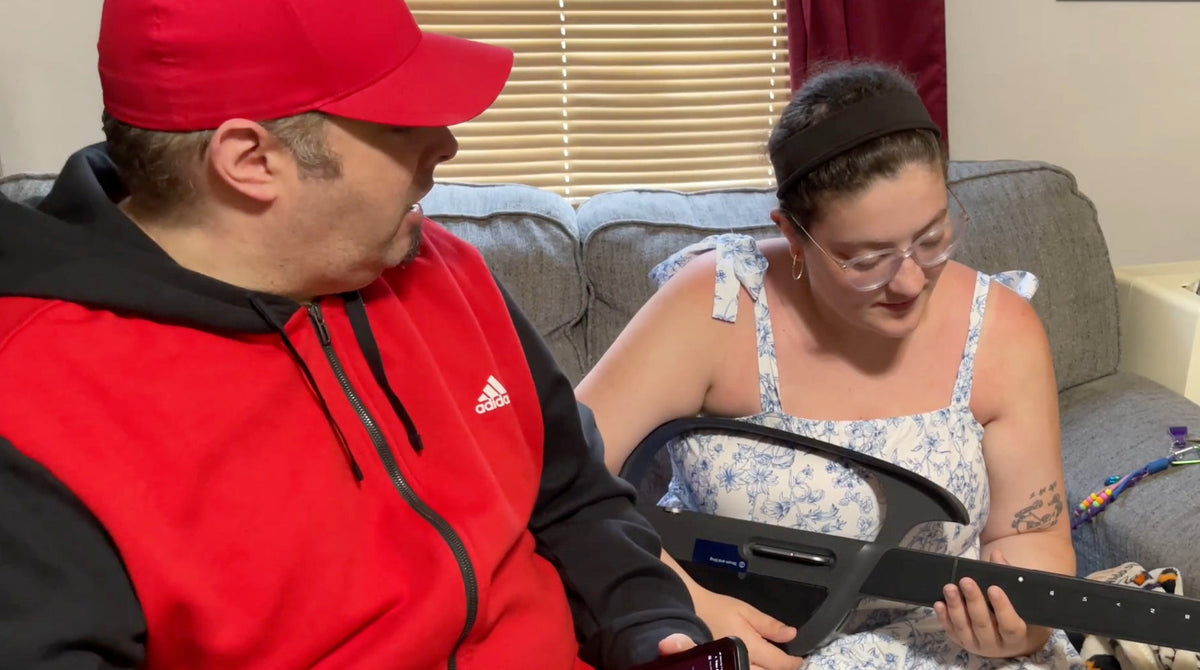
This story belongs to Tom, the creator behind the YouTube channel Melting Movies (@meltingmovies1). He shared it with us in long letters and two videos, and gave us his written permission — his blessing, really — to tell it here. Quotes are his own words, lightly edited for clarity at his own cheerful insistence.
It is 2 a.m. in Massachusetts. Tom, fifty years old, sits on the edge of his bed, keeping the volume low so his wife can sleep, playing "Father and Son" — the Cat Stevens song his dad used to sing to him — all the way through, for the first time in his life. He has owned the instrument for less than a week.
"I'm playing this thing flawless as I'm singing quietly, with tears coming out of my eyes," he wrote to us afterward.
To understand why that moment took five decades to arrive, you have to go back to a house where there was always a guitar — and a boy who could never get anyone to teach him.
Fifty years on the outside
His father played guitar in a band for eleven years, and there was always an instrument within reach when he was growing up. The guitar was the good part of a frightening house: his father struggled with what he now believes was untreated bipolar disorder, but when the guitar came out, the storm paused. "It's the only time that he seemed to be real happy," Tom remembers. "When he used to play, it just made me feel comfortable. I knew that this was a safe time." His father could patiently teach Tom's uncle to play, chord by chord — but somehow never his own son. "He would sit down with me, but he had no patience for me. What was easy for him was difficult for me." The names he got called stuck around longer than any chord shape did. Eventually, he stopped asking.
He never stopped orbiting music; he just never got to land. As an adult he bought an acoustic guitar, then an electric one. His hands wouldn't cooperate: fourteen years of driving a forklift and hauling chemical barrels at a mill had left him with nerve damage in his neck and arthritis in his hands. "No joke — if there's a quarter on the ground, I have a hard time grabbing it," he says. Pressing steel strings against a fretboard was out of the question. So Tom made music happen for everyone else instead: he drafted his four kids into a Guitar Hero family band, right down to his three-year-old son on an unplugged controller, and spent fourteen years as a pre-K teacher so that other people's children would never feel the way he had. "For eight hours, they were my children."
The bill for a lifetime of caretaking eventually arrived: CPTSD, anxiety, and a morning routine — waking in panic, shaking at the foot of the bed, slowly talking himself down — that held for twenty-eight years. His doctor wrote him a prescription that wasn't a medication: self-care. Find something that brings you joy. He was stumped. "All I've done my entire life is take care of other people. When a doctor tells you it's time for you to care for you — I didn't know what that looks like."
The letter that landed with Zoe
For about a year, an answer kept surfacing in Tom's feeds, and he hardly dared believe it: a guitar with no strings. Instead of pinning steel wire to wood, you press lit buttons and strum — the instrument does the gripping, so your hands don't have to. He watched other people's videos obsessively and ran the math against his own fingers: hands that couldn't pick up a quarter off the floor could press a button. Tom had knocked on our door once before, back when his channel was brand new, and it hadn't worked out; he kept watching from a distance anyway.
Then, this summer, Tom wrote to us again — a question about a beat-up secondhand C1 he was hoping to rescue that turned, almost by accident, into his whole story. The forklift. The fingers. The father.
It landed with Zoe on our team, and she read all of it. "I read your story — thank you for sharing," she wrote back. He wrote more, and the thread kept growing — seven, eight emails and counting, about his hands, his father, his channel, the songs he wanted to sing — with Zoe mostly listening, and telling him the thing he had trouble believing: that the way he saw this instrument, not as a gadget but as a door, might matter to other people who had long ago been told no by their hands, their history, or their own heads.
A C1 arrived at his house. Tom opened the box at two in the morning, because he could not wait, and kept the volume almost all the way down. He was playing — actually playing — that same night. No calluses to earn, no years of drills first: press, strum, and the chord simply arrives. After fifty years, the remaining distance between him and music turned out to be one evening.
The second morning
He will happily talk your ear off about the sound. But the moment he keeps returning to happened on day two, at the foot of his bed, inside the same morning routine he had known for twenty-eight years.
The guitar was standing beside the bed — he had decided not to pack it away. Mid-panic, he reached for it and switched it on, and the little startup chime did something no camera was there to record.
"It broke me out of my panic," he wrote. "Cameras can't be on me all the time, but I wish my family could have seen it. It's been the same routine for twenty-eight years."
The proud-daddy moment
Soon after, Tom's daughter stopped by the house. She had never seen the thing before. He showed her how to turn it on — and within minutes, on her very first try, she was playing and singing: "All of Me," "Every Breath You Take," "You Are My Sunshine," one after another, like she'd owned it for years. "You don't have to hold the strings down," she noticed. "It's easier for sure."
"I felt like I was in some little pub, and somebody was singing and playing music just for me," he says. "This is my twenty-something daughter, and I had a proud-daddy moment like she was four or five years old again."

She is also the one who unlocked it for him. He had been practicing for three days without quite finding the pocket. Watching her, he finally saw it: she sang, and the singing kept her strumming honest. "When you sing, it helps you know the beat of the song," she told him. That night, alone, he sang full songs for the first time in his life.
Sit with that inheritance for a second. His father could play, and couldn't teach him. Fifty years later, his daughter — on her first day ever holding the instrument — could. The guitar lesson he had waited his whole life for finally arrived, one generation late and from the opposite direction.
Her on-camera verdict, laughing: "I could definitely play this for hours and forget about my problems."
Father and son
Which brings us back to 2 a.m., and Cat Stevens.
Tom hasn't spoken to his father in twenty years. There was no storybook reconciliation, and this isn't that kind of story. But something did shift in the dark that night, somewhere between the first chord and the last.
"I picked up that guitar and played that song, and all the nasty things he said to me were forgiven," he says. "I know he was sick."
Tom plans to play it for his grandchildren one day. He is also toying with writing something of his own — "maybe there's a song in me about the stuff that's happening in my life."
The emails with Zoe haven't stopped, by the way. This story itself came out of one more round of them.
Every video on his channel ends with the same sign-off, written for strangers who might need it: "If nobody's told you lately — you are important. You are worthy."
For fifty years, music was something that happened near Tom: his father's living-room sets, his kids' game nights, other people's videos. Now it is his. That is all "music for all" has ever meant to us — not everyone becoming a musician, but everyone getting to find out that the music was meant for them, too.
He found out at fifty. Right on time.
Tom shared his letters and videos with LiberLive and gave written permission to publish them. The quotes above are drawn from that material and lightly edited for clarity. The experiences he describes — including those relating to his mental health — are his personal reflections, told in his own words, and are not medical claims or advice.
Share this article: