


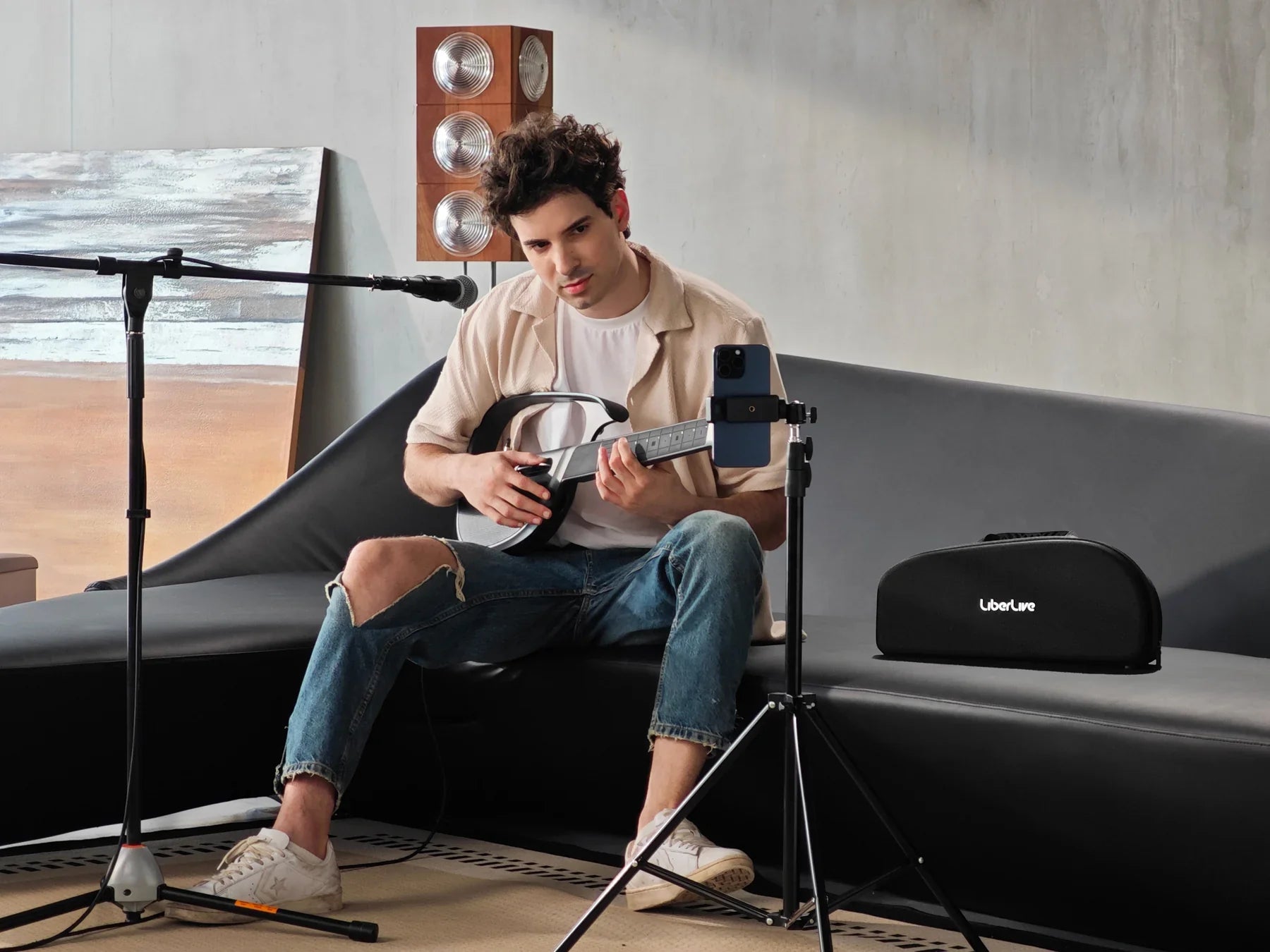
A stringless smart guitar is playable if your goal is to play songs, follow chords, sing with accompaniment, or enjoy music without starting from sore fingertips and standard chord shapes. It is less playable if you expect the same touch, tension, and technique training as an acoustic or electric guitar.
That is the honest answer. A stringless smart guitar can feel easy and fun very quickly, but its playability comes from a different design: chord pads, digital sound, guided songs, and a simplified strumming motion. It is built for access first, not for copying every detail of a traditional guitar.

Quick answer: is a stringless smart guitar playable?
Yes, for beginners and casual players, a stringless smart guitar can be very playable. The main reason is simple: it removes several early barriers at the same time. You do not have to press metal strings, build fingertip calluses, memorize full chord shapes, tune strings, or coordinate every traditional guitar movement before the first song feels recognizable.
The tradeoff is just as important. A stringless smart guitar does not train the full physical skill set of traditional guitar. It can help with timing, chord movement, song structure, rhythm, and confidence. It will not fully teach string pressure, fretboard hand strength, bends, muting, fingerstyle control, or picking dynamics.
So the better question is not whether it is a "real guitar." The better question is whether it is playable for the job you want it to do.
What "playability" means for a stringless smart guitar
With a traditional guitar, playability usually means neck comfort, string height, fretwork, tuning stability, body shape, and how the instrument responds to the player's touch. With a stringless smart guitar, the question changes.
For a stringless smart guitar, playability is mainly about five things:
- How quickly a new player can make a clean musical sound.
- How easy it is to change chords without finger strain.
- Whether the strumming or picking motion feels natural enough to keep rhythm.
- Whether the app, lights, songs, or rhythm tools help instead of getting in the way.
- Whether the instrument still feels enjoyable after the first few sessions.
That last point matters. A product can be easy for five minutes and still become boring later. Good playability means the first session is simple, but there is still enough room to keep playing: more songs, more rhythms, custom chords, sound options, and better timing.
Why it feels easier at the beginning
No finger pain from pressing strings
The first reason is physical comfort. A normal guitar asks beginners to press thin strings hard enough to make clean notes. That can hurt, especially in the first few weeks.
A stringless smart guitar avoids that specific problem. Since the player is not pressing steel or nylon strings into frets, the fingertip barrier is much lower. This makes the instrument feel more approachable for adults, teens, singers, gift recipients, and people who tried guitar once but stopped because the first stage felt too punishing.
Chord pads make changes faster
Chord changes are another early blocker. On a traditional guitar, a beginner has to place several fingers at once, press cleanly, avoid muting nearby strings, then move to the next shape without losing rhythm.
A stringless smart guitar simplifies that step. Instead of building every chord shape from scratch, the player selects chords through pads or buttons. On LiberLive C1, for example, the player presses chord pads and uses strumming paddles to produce the sound. The official FAQ also says beginners do not need guitar experience or music theory to get started.
This does not make someone a traditional guitarist overnight. It does make the first musical result easier to reach.

Strumming paddles keep the rhythm motion simple
The right-hand feel is a big part of playability. If a stringless smart guitar only had buttons, it could feel more like a remote control than an instrument.
That is why the strumming interface matters. A paddle or picking surface gives the player a rhythm motion: down, up, pause, repeat. It is simpler than controlling real strings, but it still asks the player to feel time. For many beginners, that is the useful middle ground. They can practice rhythm and song flow without fighting every part of traditional technique at once.
What still feels different from a traditional guitar
Less string tension and tactile feedback
The main difference is touch. Traditional guitar strings push back. You feel tension, vibration, pick attack, bending resistance, and small changes in pressure. A stringless smart guitar cannot fully recreate that physical feedback.
For some users, that is a benefit. It makes the instrument easier and less painful. For players who love the feel of real strings, it is a limitation. The experience is closer to a simplified performance instrument than a standard acoustic or electric guitar.
Limited transfer to advanced guitar technique
A stringless smart guitar can help with musical confidence. It can also help a beginner understand chord movement, timing, song sections, and accompaniment. Those skills matter.
But it will not fully train advanced traditional guitar technique. If your goal is barre chords, fingerstyle, bends, vibrato, palm muting, alternate picking, classical posture, or expressive electric guitar phrasing, you will still need a real-string guitar at some point.
This is not a flaw if you choose the instrument for the right reason. It is only a problem when someone expects a stringless design to do the same training job as a traditional guitar.
More dependence on battery, app, and digital controls
A traditional acoustic guitar can work anywhere as long as it is in playable condition and in tune. A stringless smart guitar is an electronic instrument, so setup matters more. Battery life, charging, speakers, line output, app features, and software support all affect the experience.
LiberLive C1 can be used without the app, according to the official FAQ, but the app adds song resources, custom chords, rhythm pattern switching, drum machine options, tempo controls, and pitch or key controls. In plain terms, the instrument can stand on its own, but many beginners will get the best playability when the app is part of the setup.

Who will enjoy the playing experience most
A stringless smart guitar makes the most sense for people who want music to feel playable sooner. It is especially useful when the goal is accompaniment, casual practice, or singing with chords.
| User type | Fit | Why |
|---|---|---|
| Complete beginner | Strong fit | Lower finger pain and chord-shape difficulty. |
| Singer | Strong fit | Easy chord backing helps the voice stay central. |
| Casual home player | Strong fit | Fast setup, built-in sound, and guided songs reduce friction. |
| Gift buyer | Good fit | The recipient does not need a long learning plan before trying songs. |
| Traditional guitar student | Limited fit | It does not replace real-string technique practice. |
If you want to sing at home, play recognizable songs, bring music to a small gathering, or try an instrument without weeks of painful setup, the playing experience can feel refreshingly direct.

Who should choose a traditional guitar instead
Choose a traditional guitar if your main goal is traditional guitar skill. That includes acoustic strumming technique, electric guitar phrasing, classical study, fingerstyle, improvisation on real strings, or long-term fretboard training.
A stringless smart guitar can still be useful as a companion. It can help you sing, sketch songs, practice timing, or enjoy music on low-energy days. But if your definition of playability depends on string response and technique transfer, a regular guitar is the more direct route.
How LiberLive C1 fits this use case
LiberLive C1 fits the stringless smart guitar use case clearly. It is built around a simple interaction: press a chord, strum with the paddle, and follow the app when you want guided songs or more control.
The official product page lists a stringless design, 10,000+ songs with the LiberLive free guitar app, 14+ style packs, 6+ hours of battery life through built-in speakers, 3.94 lb weight, Type-C charging, and 3.5 mm audio output. The app page describes chord sheets, light guidance, rhythm patterns, tutorial videos, custom chords, and guitar, piano, and bass sound options.
Playability includes more than the hardware. For beginners, the next question is usually "What do I play now?" The LiberLive app helps answer that with chord sheets, guidance, rhythm controls, and tutorials. If you want setup and support details before buying, the LiberLive FAQs are the better place to check app use, left-handed use, tuning, and other common questions.
If you want the fuller product overview, read the LiberLive C1 guide. If you already know you want the low-friction playing path, start with the LiberLive C1 product page.
FAQ
Is a stringless smart guitar easier than a regular guitar?
Usually, yes at the beginning. It removes string pressure, traditional chord-shape difficulty, and tuning friction. A regular guitar becomes more expressive later, but it asks for more physical practice upfront.
Does a stringless smart guitar feel like a real guitar?
It feels guitar-like in layout and rhythm, but it does not feel the same as real strings. The playing experience is better understood as simplified accompaniment rather than a direct copy of acoustic or electric guitar technique.
Can beginners play songs on a stringless smart guitar?
Yes. That is one of the strongest use cases. Chord pads, guided songs, and simpler strumming help beginners reach recognizable songs faster than they usually would on a traditional guitar.
Can it teach traditional guitar?
Only partly. It can support rhythm, timing, chord movement, and song confidence. It does not fully teach finger strength, fretboard accuracy, picking control, string muting, bends, or other real-string techniques.
Does LiberLive C1 need the app to be playable?
No. The official FAQ says C1 can be used without the app. The app adds more features, including song resources, custom chords, rhythm pattern switching, drum machine options, tempo adjustments, and pitch or key controls.
Final takeaway
A stringless smart guitar is most playable when you judge it by the right goal. It is not trying to beat a traditional guitar at traditional technique. It is trying to make songs, chords, rhythm, and singing feel reachable sooner.
If you want full guitar technique, choose a real-string guitar. If you want a lower-friction way to play songs, sing with chords, and enjoy music without the hardest first steps, a stringless smart guitar can make sense.
For that use case, LiberLive C1 is the most relevant place to start.
Share this article:
Party Essentials Checklist: 10 Must-Haves for a More Fun Gathering